Use Nir Eyal's Hooked model to build addictive products in four simple phases.
Created by Workflowy.
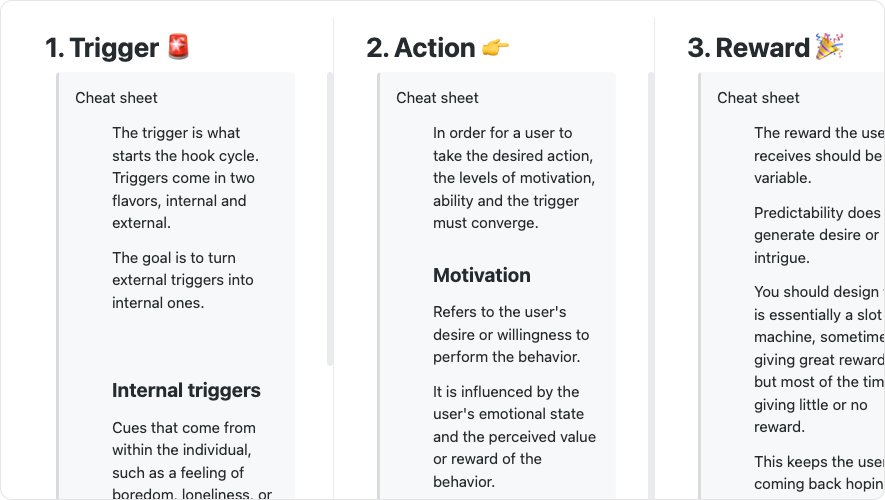
The Hook Model is a framework for understanding how new habits are formed. It consists of four key elements: a trigger, an action, a reward, and an investment. This model comes from Nir Eyal's 2013 book 'Hooked: How to Build Habit-Forming Products'. The model presents a four phase process to create 'hook cycles' that keep users coming back to your product or service
Trigger: The first step in the Hook Model is a trigger, which is a cue that initiates the behavior. Triggers can be internal (such as a feeling of boredom) or external (such as a notification on a phone).
Action: The action is the behavior that is performed in response to the trigger. It can be a physical action (such as scrolling through social media) or a mental action (such as thinking about a problem).
Reward: The reward is the benefit that is received from performing the action. It can be tangible (such as receiving a notification) or intangible (such as feeling entertained).
Investment: The final step in the Hook Model is an investment, which is an action that improves the trigger-action-reward loop for the next time. This can include things like leaving the app open or setting a reminder for the next time.
By understanding the elements of the Hook Model, it's possible to design products and services that create habit-forming experiences for users
To learn more about The hooked model, check out Nir Eyal's blog.
Radical clarity and focus are only a signup away
Sign up What is Workflowy?

 Copy template


